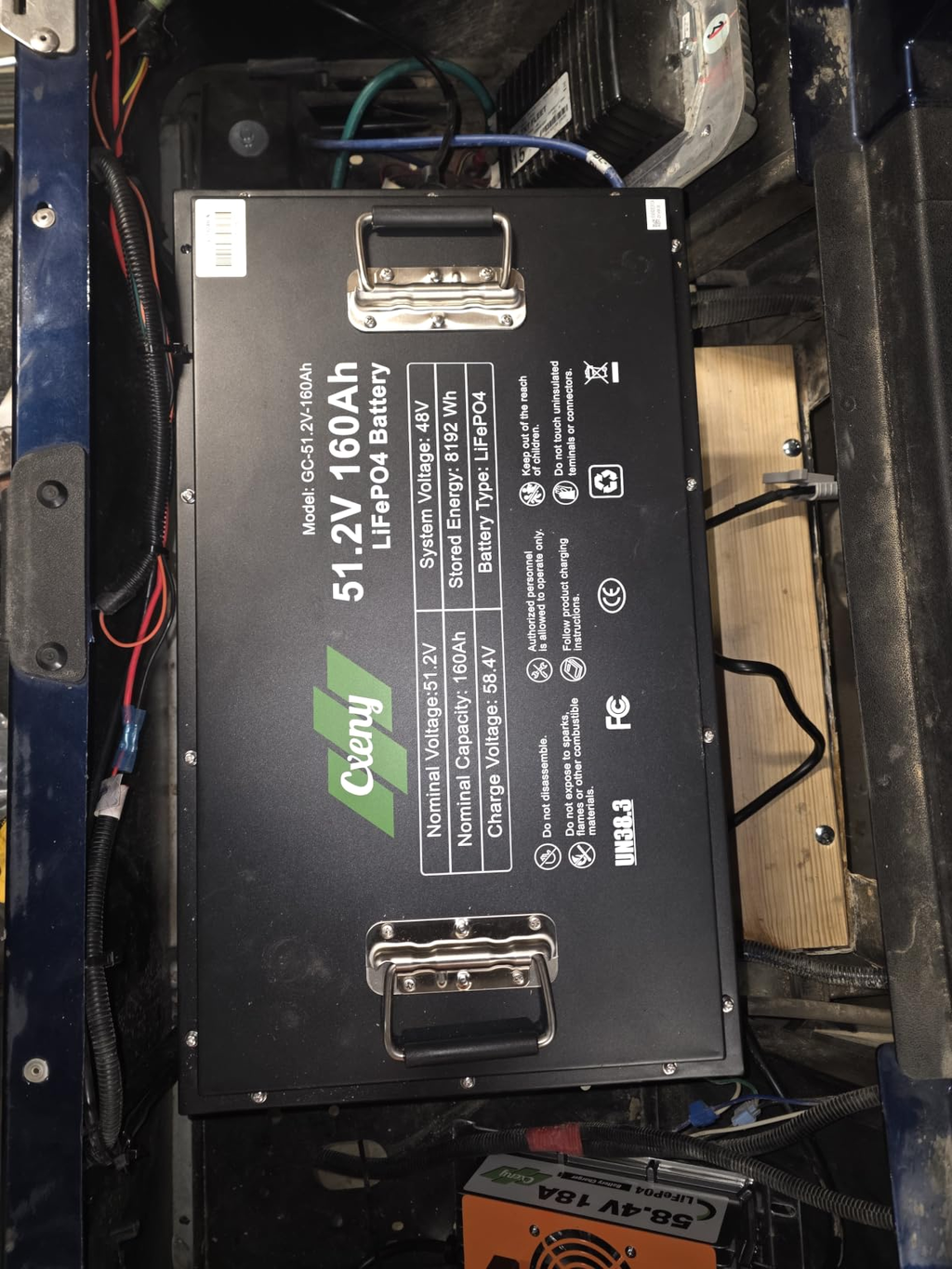
48V 160Ah Golf Cart Lithium Battery | 100km Long Range with 18A Charger

51.2V 160Ah Golf Cart LiFePO4 Battery Kit | Lithium, Charger, LCD Monitor Included
Get everything you need with this Cxeny 51.2V 160Ah golf cart LiFePO4 battery kit, including a charger, LCD monitor, hardware, and manual for quick setup.

Cxeny Grade A LiFePO4 Battery | 8.19kWh, 400A Peak, 8000+ Cycles
Cxeny Grade A LiFePO4 battery delivers 8.19kWh usable energy, 400A peak discharge, 200A continuous output, and over 8000 cycles for golf carts.

Ultimate Safety LiFePO4 Battery | Cxeny 16S 200A BMS with Full Protection
Prioritize safety with Cxeny LiFePO4 battery. Equipped with 16S 200A smart BMS, auto-balancing, and comprehensive overcharge/short-circuit protection, reliable and secure.

Smart APP Real-Time Monitoring
Support remote mobile APP control, allowing you to check voltage, current, temperature, SOC (State of Charge), and protection status anytime, anywhere—stay in full control of your battery’s performance.

100km Industry-Leading Long Range
Equipped with a 160Ah high-capacity LiFePO4 cell, this battery delivers an impressive 100km single-charge range—enough to power full-day golf rounds, extended off-road trips, and heavy-duty use without frequent recharging or range anxiety.

Designed Exclusively for 48V Golf Cart Replacement
Crafted specifically as a direct replacement for 48V golf carts, this LiFePO4 battery perfectly matches factory specifications, ensuring seamless compatibility with major golf cart brands including Club Car, E-Z-GO, Yamaha, Cushman, and Star EV. No extra adapters or modifications are needed for a hassle-free upgrade.

Versatile Compatibility: Beyond Golf Carts
This 48V 160Ah LiFePO4 battery fits lawn mowers, forklifts, marine gear & 48V devices, with scalable modular design for recreation/industry.
| Item | Specification |
|---|---|
| Nominal Voltage | 51.2V |
| Nominal Capacity | 160Ah |
| Energy | 8.192kWh |
| Max Continuous Output Power | 10.24kW |
| BMS | 16S 200A |
| Charge Voltage | 58.4V (3.65V/cell) |
| Discharge Cut-off Voltage | 40V (2.50V/cell) |
| Recommended Charging Current | ≤80A (0.5C) |
| Recommended Discharging Current | ≤160A (1C) |
| Max. Charging Current | 160A |
| Max. Continuous Discharge Current | 200A |
| Peak Discharge 35 Sec | 400A |
| Operating Temperature Range | Charge: 32°F to 113°F (0°C to 45°C); Discharge: -4°F to 140°F (-20°C to 60°C) |
| Cycle Life | ≥8000 Cycles |
| Communication | Bluetooth, RS485 |
| Dimensions | 22.83*13.19*10.35 inch / 580*335*263 mm |
| Safety Features | Over charge/discharge, Over current, Short circuit, High/low temp cut-off |
| Series Connectable | Not Support |
| Package List | 51.2V 160Ah Golf Cart Battery, 58.4V 18A LiFePO4 Charger, Product Manual, 2.8in LCD Screen and Monitor cable, Display Bracket, Screws |
Does it come with a charger?
▼
Does it come with a charger?
Not all listings include a charger. Please check the listing description or consult customer service.
Is this battery compatible with all golf cart models?
▼
Is this battery compatible with all golf cart models?
Cxeny golf cart batteries are compatible with 99% of well-known brand golf carts, such as Club Car, E-Z-GO, Yamaha, Cushman, Star EV, etc. Other brands are generally also compatible. If you have any questions, please consult customer service.
Does it have a monitoring system?
▼
Does it have a monitoring system?
Yes, the battery has two monitoring methods: one is monitoring via a mobile app, and the other is viewing the battery status and health through a dedicated golf cart battery touchscreen display.
Can I replace my lead-acid batteries directly with lithium?
▼
Can I replace my lead-acid batteries directly with lithium?
Generally, yes, but you must ensure the voltage matches (e.g., 36V or 48V) and use a dedicated lithium-ion battery charger.
Can this battery be used in marine applications?
▼
Can this battery be used in marine applications?
Yes. Our LiFePO₄ batteries are suitable for marine applications such as fishing boats and electric vessels. Please ensure the installation environment is dry and well-ventilated, and avoid prolonged exposure to water or submersion. For saltwater environments, additional protective measures are recommended.
Should I fully drain the battery before charging? What is the expected lifespan of the battery?
▼
Should I fully drain the battery before charging? What is the expected lifespan of the battery?
We recommend keeping the battery's state of charge (SOC) above 10% and avoiding complete discharge—when the voltage drops too low, the battery management system (BMS) will automatically cut off power output to protect the battery. Under normal usage conditions, Cxeny lithium iron phosphate batteries have a cycle life of over 8,000 cycles and a service life of over 10 years, depending on usage frequency, depth of discharge, and maintenance.
Is this battery easy to install?
▼
Is this battery easy to install?
Installation is straightforward, and the battery can typically directly replace the original lead-acid battery pack. Ensure voltage compatibility (e.g., 36V/48V) and use a dedicated lithium battery charger.
Do I need a new charger for lithium batteries? Can I still use my old lead-acid charger?
▼
Do I need a new charger for lithium batteries? Can I still use my old lead-acid charger?
We recommend using a dedicated lithium battery charger. Lead-acid chargers have a charging profile unsuitable for lithium batteries and may affect battery life or safety over time.
How do I store the battery during winter/off-season?
▼
How do I store the battery during winter/off-season?
We recommend storing the battery at 50%--80% charge in a dry, non-corrosive environment with temperatures between 0°C and 25°C. Check the charge level every 2--3 months and recharge if necessary.
How does cold weather affect performance?
▼
How does cold weather affect performance?
In cold environments (below 0°C), battery capacity may temporarily decrease and charging efficiency may be reduced, but the device will still function normally. To maintain battery performance and lifespan, we recommend avoiding prolonged use or charging in cold temperatures.
Will a lithium battery make my cart climb hills better?
▼
Will a lithium battery make my cart climb hills better?
Yes. Lithium batteries provide more stable voltage output during hill climbing, with significantly less voltage drop compared to lead-acid batteries, resulting in stronger and more consistent power on inclines.
How steep of a hill can this battery handle?
▼
How steep of a hill can this battery handle?
The actual climbing ability depends primarily on motor power, controller, and total load. Cxeny lithium batteries do not inherently limit gradient capability.
Why does my cart slow down going uphill with lead-acid but not with lithium?
▼
Why does my cart slow down going uphill with lead-acid but not with lithium?
Lead-acid batteries experience a significant voltage drop under high-current discharge, reducing motor power. In contrast, lithium batteries have low internal resistance and maintain stable voltage, enabling sustained power output and consistent speed on inclines.
Does a higher Ah battery help with hills?
▼
Does a higher Ah battery help with hills?
To some extent. A higher capacity battery can provide more stable discharge voltage and longer sustained high-current output, which is beneficial for long-distance or frequent hill climbing.
Is this battery good for lifted carts or utility carts that climb hills often?
▼
Is this battery good for lifted carts or utility carts that climb hills often?
Yes. Cxeny lithium batteries offer strong high-current discharge capability and stable voltage, making them ideal for lifted carts, utility carts, or applications involving frequent hill climbing.
Will climbing hills with passengers damage the battery?
▼
Will climbing hills with passengers damage the battery?
No. As long as the battery is used within its rated discharge current, climbing with passengers is a normal operating condition. The built-in BMS protects the battery from overcurrent, overheating, and other potential issues.
Why does my battery get warm when climbing long hills?
▼
Why does my battery get warm when climbing long hills?
During prolonged hill climbing, the battery continuously discharges at high current, generating some heat. This is normal. Cxeny lithium batteries use high-quality cells and thermal management, producing significantly less heat than lead-acid batteries. If temperature rises abnormally, the BMS will activate protection.
Is lithium better than lead-acid for hills?
▼
Is lithium better than lead-acid for hills?
Yes. Lithium batteries offer more stable voltage, stronger power output, less heat generation, and longer range on hills, delivering significantly better overall performance than lead-acid batteries.